Bills-Vikings Fantasy Preview: Josh Allen’s Floor Meets Minnesota’s Pass Defense
Allen remains a starter, but Minnesota’s defense lowers expectations. The Vikings’ quarterback choice could swing Justin Jefferson’s value.
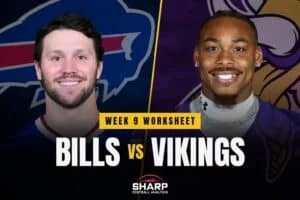
Buffalo’s matchup with Minnesota puts two sharply different profiles in focus: the Bills lead the league in scoring, while the Vikings have allowed the fewest points per drive. That tension shapes the fantasy outlook. Josh Allen is still a must-start, but this is a tougher passing spot than his usual production suggests; on the other side, the health of Kyler Murray could change how much upside Justin Jefferson carries.
The broader numbers underline the contrast. Buffalo averages 33.3 points per game, ranks second in offensive yards per play at 6.3, and produces a league-best 3.07 points per drive. Minnesota gives up only 13.3 points per game and 4.7 yards per play, both first in the league, and allows just 1.18 points per drive. Yet the Vikings’ offense averages only 20.0 points per game and 1.75 points per drive, ranking 27th and 28th, respectively.
These teams also bring very different scoring environments. Bills games average a league-high 59.1 combined points; Vikings games average a league-low 33.3, and Minnesota is 6-1 to the under. Buffalo is favored by 3.5, with an implied total of 24.75 points against 21.25 for Minnesota. The matchup’s central question is whether Buffalo can impose its efficient early-down attack before the Vikings’ defense makes the game slower and less forgiving.
Find a breakdown of every Week 9 NFL game in our Worksheet Hub.
Allen’s running keeps his ceiling intact
Allen has finished outside the top 10 fantasy quarterbacks only once this season and has scored fewer than 20 standard fantasy points in three games. The Vikings, however, have yet to allow a top-10 scorer at the position and have given up 28.9 total passing points across their past six games. Minnesota has allowed only four passing touchdowns all season, with two coming in Week 1.
That makes Allen’s rushing work especially relevant. He averages 11.6 fantasy points per game on the ground, giving him a reliable path to production even if Minnesota makes the passing game difficult. The Vikings bring pressure with enough bodies to make scrambles harder to come by, so short-yardage touchdowns could matter more than long runs. Allen remains in lineups; the matchup simply calls for more restrained expectations than his season-long standing might suggest.
Buffalo’s personnel helps it avoid a major change in approach. The Bills rank 28th in 11 personnel, using it on 46% of plays, and second in 13 personnel at 27.1%; their 12-personnel rate is 21.6%, 17th. Minnesota has pushed opponents toward heavier groupings and a more run-focused plan. Teams throw 6.1% less often than expected against the Vikings, the lowest rate in the league. Buffalo already runs on 49.9% of its plays, second-most in the NFL.
One concern is Buffalo’s recent third-down slide. The Bills converted 10 of 32 third downs (31.3%) over their past three games, ranking 30th in that span, after converting 24 of 45 (53.3%), the league’s second-best rate. They remain dangerous when they get ahead of the sticks: 72.7% of their first downs or touchdowns come on early downs, second-best in the league, and they average 5.1 plays of at least 20 yards per game, most in the NFL. Minnesota, by contrast, ranks last in offensive success rate on early downs at 30.7%, and 59.1% of its sets of downs reach third down, the highest rate.
Murray’s status sets Minnesota’s passing outlook
Murray’s hamstring injury leaves his availability for Monday uncertain. Minnesota has said the injury is not considered “really bad,” and coach Kevin O’Connell said the team is committed to him as its starter if he is healthy. If Murray can’t play, Carson Wentz would start. Either quarterback profiles as a matchup-dependent QB2, with Murray’s rushing adding upside if the injury doesn’t limit his movement. He has averaged 31.6 rushing yards in his full games.
O’Connell’s assessment after the Vikings’ first loss offered a mixed read on the offense’s rhythm:
Kevin O’Connell on Kyler Murray:
“I thought he made some big-time throws. There were some positives, but there are still some plays we're leaving out there that will help with the overall rhythm of the game. We've gotta continue to find the best way to get him comfortable.”
— Will Ragatz (@WillRagatz) November 1, 2026
Murray finished as the week’s QB8 with 19.9 fantasy points, but the fit with O’Connell’s offense remains a question in the source analysis. The Vikings took a chance on a quarterback who was affordable and available; now they need the pieces to work together. Jefferson’s visible frustration after the loss sharpened that concern. If Wentz gets the start, Jefferson’s past production with him offers a reason for optimism. If Murray plays, the receiver remains a volatile option, with both his ceiling and weekly consistency tied to the quarterback’s health and accuracy.
Buffalo’s passing defense has been more vulnerable in the second half. For the full season, the Bills allow 18.5 passing points per game, ranking 31st, and opponents average 7.0 yards per attempt, 15th. They face 38.3 pass attempts per game, also 31st, and have allowed a 5.6% touchdown rate, 22nd. In the first half, though, they have allowed 6.2 yards per attempt, 9.6 yards per completion and 92.6 passing yards per game. Those figures rank ninth, fifth and 11th, respectively.
After halftime, opponents average 7.6 yards per attempt and 12.4 yards per completion against Buffalo, while passing for a league-high 162.1 yards per game. Ten of the 15 touchdowns the Bills have allowed through the air came in the second half. That split gives Minnesota a possible route to production if it can stay close long enough to exploit it, though the Vikings haven’t shown much explosive gear. Wentz’s Week 1 performance is the clearest example of a stronger passing stretch.
Cook has a run-first path against a fading front
James Cook is coming off 23 touches, 101 total yards and a touchdown, and he has scored in six straight games. Ty Johnson’s return cut Cook’s route rate to 32.4%, reinforcing his value as a rushing-centered RB1 rather than a receiver-driven option. Buffalo runs on 57% of Cook’s snaps, the fourth-highest rate among running backs.
Minnesota’s defense is imposing early, then has given up more ground after the break. The Vikings have allowed running backs 3.8 yards per carry in first halves, 12th in the league, with a 72.7% success rate, third-best. In second halves, that rises to 5.3 yards per carry, 29th, while the success rate falls to 60.4%, 24th.
Recent opponents have leaned into that pattern. The Colts ran 29 times with their backs in Week 7; Detroit had 34 backfield runs on Sunday. Chicago ran its backs 26 times in Week 2, a possible early signal that the approach could work. Against Detroit, Minnesota allowed 66 yards on 16 runs in the first half, then 152 yards on 18 in the second. Jahmyr Gibbs wasn’t alone in the late surge: Sione Vaki added 65 yards on 11 carries.
The Vikings’ offense has struggled to put teams away, which can leave its defense on the field and prevent the unit from forcing opponents into obvious passing situations. Buffalo’s run-heavy tendencies make it well suited to keep attacking that vulnerability. Cook’s recent touchdown streak and workload keep him firmly in the starting conversation, even with Minnesota’s strong first-half run defense.
Minnesota’s split backfield offers little margin
Jordan Mason and Aaron Jones continued to divide work last week. Jones played 38% of the snaps and recorded seven touches for 40 yards; Mason played 28% and had eight touches for 20 yards. Jones arrived banged up, so DeeJay Dallas handled a narrow passing-down role, playing 17 snaps. He had one touch, stayed in to block eight times and ran seven routes; Minnesota passed on 88.2% of his snaps.
That leaves Mason and Jones as touchdown-dependent RB3 options. Jones has some added value through the air, a useful trait against a Buffalo defense that allows 13.0 receiving fantasy points per game to running backs, 30th in the league. Backs account for 24.9% of the receptions the Bills surrender, the fifth-highest rate. Buffalo is more stout against the run, allowing 3.7 yards per carry, ninth-best, but has given up seven rushing touchdowns to backs, ranking 22nd.
Jefferson’s matchup is strong; the quarterback matters more
Jefferson caught five of nine targets for 33 yards and a touchdown on Sunday, making a difficult, contested catch for his score. The rest of the day was less encouraging: 33.3% of his targets were inaccurate, his highest rate in a game this season. In his full games, he has commanded 30.9% of Minnesota’s targets and 37.8% of its air yards, but has produced only one WR1 scoring week. The offense ranks 27th in dropbacks per game at 33.0.
His numbers with Wentz point to a higher ceiling. Across seven games with Wentz, Jefferson has averaged 6.1 catches and 87.6 yards per game, with 31.5% of the targets, 45.2% of the air yards and 2.52 yards per route run. Three of his four WR1 scoring weeks since last season came with Wentz. A Wentz start would strengthen Jefferson’s case as a WR1; with Murray, he looks more like a volatile WR1/WR2.
The Bills are a favorable opponent for the lead receiver. They allow 22.2 points per game to opposing WR1 targets, most in the league, and have surrendered eight touchdowns to that group, also a league high. Ladd McConkey and Zay Flowers are the only lead wide receivers who haven’t finished as WR1 scorers against Buffalo. That matchup gives Jefferson room to deliver if the quarterback can get him the ball accurately.
Not too hard to see why Justin Jefferson is frustrated. These are bad misses from Kyler Murray. pic.twitter.com/dZxoZmerCF
— Will Ragatz (@WillRagatz) November 2, 2026
Moore’s return reshapes Buffalo’s targets
D.J. Moore returned against Baltimore and caught four of seven targets for 82 yards and a touchdown. He showed no apparent workload limitation, running a route on 89.2% of dropbacks. In his three full games this season, Moore has received 28.7% of targets and 42.5% of air yards, with 3.04 yards per route run. His 26% target rate per route and 15.1 air yards per target are both career highs; only 7.4% of his targets have been inaccurate, a career-low rate if it holds.
Those are WR1-level usage indicators, but Minnesota’s ability to suppress passing volume makes Moore more of a WR2 for this matchup. The Vikings allow 7.4 yards per target to receivers, 10th, and a 3.5% touchdown rate, eighth. Allen’s production has also been strongest with Moore available: he has averaged 9.1 yards per attempt, 13.7 yards per completion and a 66.3% completion rate in those games.
Khalil Shakir has a more complicated route to volume. He leads Buffalo with a 30.6% target share on routes against the blitz, but his playing time is tied to personnel. He has run a route on 66.2% of dropbacks overall and only 39.8% when Buffalo uses multiple tight ends. When he does run routes in heavier sets, he has averaged 4.31 yards per route. With just one end-zone target, Shakir is a floor-based WR4/FLEX play rather than a strong touchdown bet.
Jordan Addison’s appeal rests on explosive plays. He caught three of eight targets for 66 yards against Detroit, including a 51-yard deep catch on Murray’s best throw of the game. Addison has recorded only one top-30 scoring week this season, which came when Jefferson exited after two routes and scored his only touchdown of the season. His 15.8 air yards per target come with an inaccurate-target rate of 24.2%. He’s a volatile WR4/FLEX who needs to convert a deep opportunity. Buffalo has allowed completions on seven of 21 throws to receivers at least 20 yards downfield (33.3%), but four of those seven completions went for touchdowns.
Keon Coleman could return to the rotation with Josh Palmer banged up. Still, with Moore on the field, Coleman has drawn a target on only 12.7% of routes and has averaged 0.81 yards per route. That makes him a touchdown-or-bust option for single-game fantasy lineups.
Tight ends face a difficult assignment
Dalton Kincaid’s four catches on six targets for 86 yards and a touchdown last week showed his upside, and his route production has been better with Moore active: 3.32 yards per route run compared with 2.02 without Moore. The Vikings’ defense, however, makes this a poor matchup for a tight end whose work overlaps with blocking duties. Kincaid plays 35.2% of snaps in the slot and 16.2% out wide, but Buffalo runs on only 43.1% of his snaps, compared with 67.6% for Jackson Hawes and 53.2% for Dawson Knox.
Minnesota has limited tight ends working from those receiving alignments, allowing eight catches on 15 targets (53.3%) and 4.8 yards per target. The Vikings give up a league-low 1.13 fantasy points per target to tight ends and are one of two teams yet to allow a touchdown to the position. After the routes for Colston Loveland and Juwan Johnson fell below their season rates against Minnesota, Kincaid profiles as a TE2 on Monday.
T.J. Hockenson is a steadier option for Minnesota. He caught four of five targets for 58 yards and a touchdown, his second straight game with a score. He’s averaging 4.4 catches per game and holds a 20.4% target share, sixth among tight ends. His yardage ceiling has been modest—his only game above 60 yards came without Jefferson—but the role gives him a usable floor near the TE1/TE2 line. Buffalo allows 6.1 tight-end receptions per game, 24th, but has given up only one touchdown to the position.
The decision points are clear: keep Allen and Cook in starting lineups, temper passing expectations against Minnesota, and monitor Murray’s availability for its effect on Jefferson and Hockenson. Buffalo’s late-game passing defense gives the Vikings a path to a stronger second half, while the Bills have the personnel and patience to test Minnesota’s run defense over four quarters.

More Week 9 Fantasy Breakdowns From The Worksheet:
| Week 9 NFL Games | Time |
|---|---|
| Jaguars @ Ravens | Thursday Night Football |
| Bengals vs. Falcons | Sunday -- 9:30 a.m. ET |
| Jets @ Chiefs | Sunday -- 1 p.m. ET |
| Cowboys @ Colts | Sunday -- 1 p.m. ET |
| Lions @ Dolphins | Sunday -- 1 p.m. ET |
| Browns @ Saints | Sunday -- 1 p.m. ET |
| Giants @ Eagles | Sunday -- 1 p.m. ET |
| Rams @ Commanders | Sunday -- 1 p.m. ET |
| Broncos @ Panthers | Sunday -- 1 p.m. ET |
| Texans @ Chargers | Sunday -- 4:05 p.m. ET |
| Packers @ Patriots | Sunday -- 4:25 p.m. ET |
| Raiders @ 49ers | Sunday -- 4:25 p.m. ET |
| Cardinals @ Seahawks | Sunday -- 4:25 p.m. ET |
| Buccaneers @ Bears | Sunday Night Football |
| Bills @ Vikings | Monday Night Football |