Servite and Rosary Put California Sprint Relay Records in Reach
Servite’s boys and Rosary’s girls rewrote California relay history in 2026. Coach Brandon Thomas sees national records within reach.
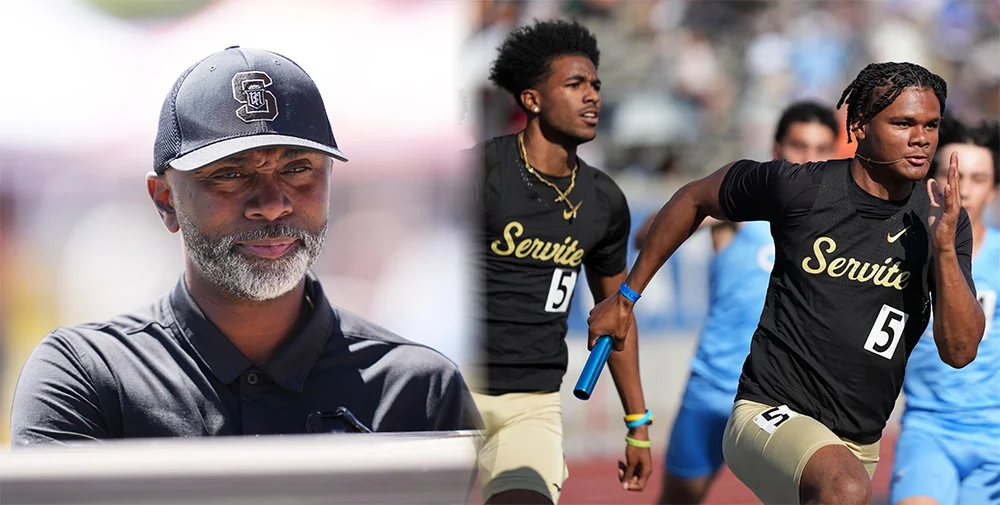
California’s sprint relay standard has a new center of gravity. Servite’s boys and Rosary’s girls, coached by Brandon Thomas, turned record-level times into a shared program identity in 2026. Their next target is bigger: Thomas believes all three boys’ relay national records are within reach, while Rosary’s young group is positioned to remain among the country’s best.
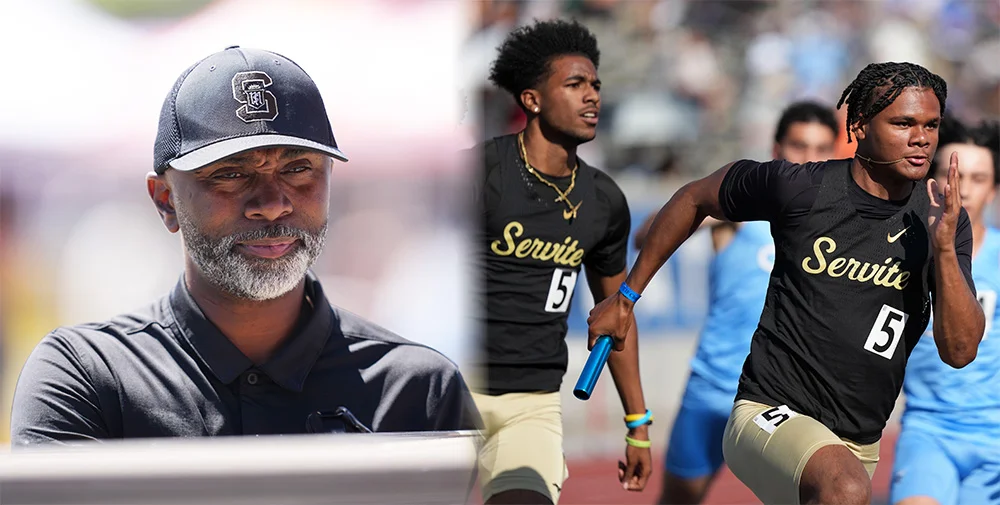
The scale of Servite’s season is clearest in the times. At the Arcadia Invitational, Jace and Jorden Wells, Kamil Pelovello and Benjamin Harris ran 39.70 in the 4×100. The day before, Jace Wells, Pelovello, Jaelen Hunter and Harris clocked 1:22.76 in the 4×200. At the State Meet, the Wells twins, Pelovello and Hunter crossed in 3:07.62 for the 4×400.
Those marks placed the Friars fourth, fourth and third all-time in their events, with top All-America rankings in all three. The 39.70 and 3:07.62 were also U18 world records. The 4×400 came close to Hawthorne’s 3:07.40, a national mark that had stood for 41 years. Servite’s quartet was made up entirely of sophomores, making the narrow gap feel less like a ceiling than a warning.
Competition unlocked the 39-second barrier
Servite had announced itself a year earlier, running 40.00 in the 4×100 and 1:23.88 in the 4×200 at Arcadia with three freshmen and a sophomore. But Thomas says the boys spent too much of the rest of that season chasing a number instead of racing the field. In 2026, they focused on competing; the sub-40 time followed.
“Once the boys got focused [in ’26] and were just ready to compete, the 39 happened,” Thomas said. The result lifted pressure, and Servite ran 39 seconds five times during the season, the first high school team to do so, according to the source.
The 3:07.62 surprised the runners as much as it impressed the crowd. Hunter said the team’s priority had been setting a State points record while completing a 60-point CIF title performance. They expected a time in the low 3:08 range or high 3:07s, not the mid-3:07 result that put Hawthorne’s long-standing mark squarely in view.
“When I crossed the line, I was like, ‘There’s no way!’” Hunter said. That reaction captures the season’s defining quality: Servite’s biggest performances came when the quartet raced with a clear competitive task, rather than treating the clock as the opponent.
Rosary made its own record claim
Rosary’s 4×100 deserves equal billing. The quartet of sophomores Tra’via Flournoy and Maliyah Collins, junior Pfeiffer Lee and senior Justine Wilson ran 44.23, erasing Long Beach Poly’s 44.50 State Record from 2004. Duncanville matched Rosary’s time nationally, and the Royals finished third in the All-America compilation.
Their strongest national position came in the 4×200. A 1:34.28, built through close wins over Wilson in April, put Rosary second on the list behind Lancaster, Texas. The 3:41.33 in the 4×400 didn’t make the national ranking, but only national leader Wilson ran faster in California.
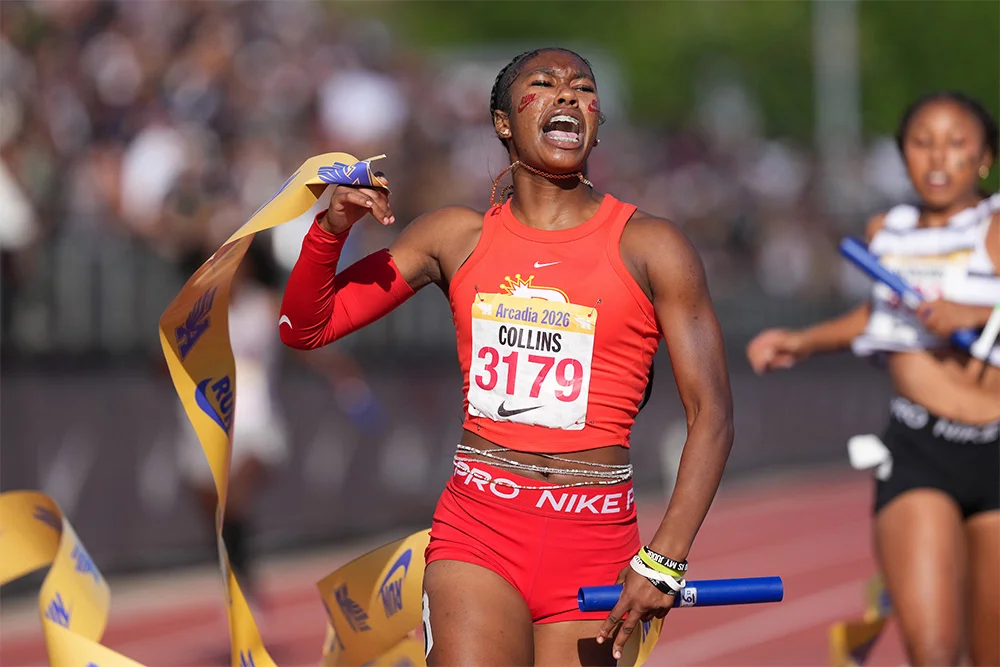
Rosary’s progression was already visible in 2025, when the team ran 45.47 at Arcadia and 45.21 at Mt. SAC. Thomas expected the State Record to fall in 2026, but not so early. He pointed to Calabasas as a spur in the 4×100: an early-season loss sharpened the Royals’ preparation for Arcadia, where they arrived ready to race. Wilson provided a similar push in the 4×200.
Thomas built the groups around trust
Thomas has coached Servite’s sprinters since 2018, when his son Max began his prep career. He became Rosary’s head coach in 2021 and took over at Servite the following year, succeeding retiring coach Richard Gibbs. Before that, he worked at East Los Angeles College and Long Beach City, and co-founded Evo Track Club and Evo Sports Training. His coaching background includes athletes from youth competition through the professional ranks.
A Long Beach and UCLA sprinter in the 1990s, Thomas learned from John Smith and Tommie Smith. His relay emphasis is direct: get the baton through each exchange zone as quickly as possible. That requires planned steps, precise timing and confidence between runners. Speed matters, but a fast quartet can lose its advantage if its members don’t trust their marks and each other.
Thomas also sees the athlete beyond the relay card. He says development away from the track helps runners arrive ready to compete, and that he makes time to talk with athletes about subjects beyond running. The approach has helped him build continuity across two schools while adding talent to groups that were already developing.
At Servite, Max’s success helped draw attention to the program. Alex Skalmowski, a 2023 Southern Section Division 3 champion in the 100 and 200, then helped attract Robert Gardner Jr. Gardner ran a legal 10.77 as a freshman, while junior Quaid Carr clocked 10.74. Gardner’s decision to join Servite helped bring in Hunter, Pelovello, the Wells twins and Harris.
Hunter recalled that early meets in 2025 quickly showed the group what it might become: first a 41-low, then another 40-second relay. Chemistry built from there, carrying the team into its record-setting junior year. The core’s youth makes another jump plausible, but exchange execution and the ability to keep racing freely will decide how far the times fall.
Next targets are national marks
Rosary must replace Wilson, now at Illinois, though her younger sister Jasmine is due to join as a freshman. Thomas expects the girls to match or improve on last season’s level. The 44.23 gives them a clear benchmark, while the 4×200 results show they can win tight races against strong opposition.
For Servite, Thomas has set an even higher bar. He first named 38 seconds in the 4×100 as a goal, then widened the ambition to breaking the national records in the 4×100, 4×200 and 4×400. He considers all three realistic. The times from 2026 have already changed the question for California’s sprint relays: the records are no longer distant reference points. They’re the targets these young squads can race toward.