Yogi Roth’s NBC Blueprint: Coach Viewers, Let the Game Lead
After nearly two decades in college football, Roth brings a coach’s preparation and a storyteller’s restraint to NBC’s Saturday broadcasts.
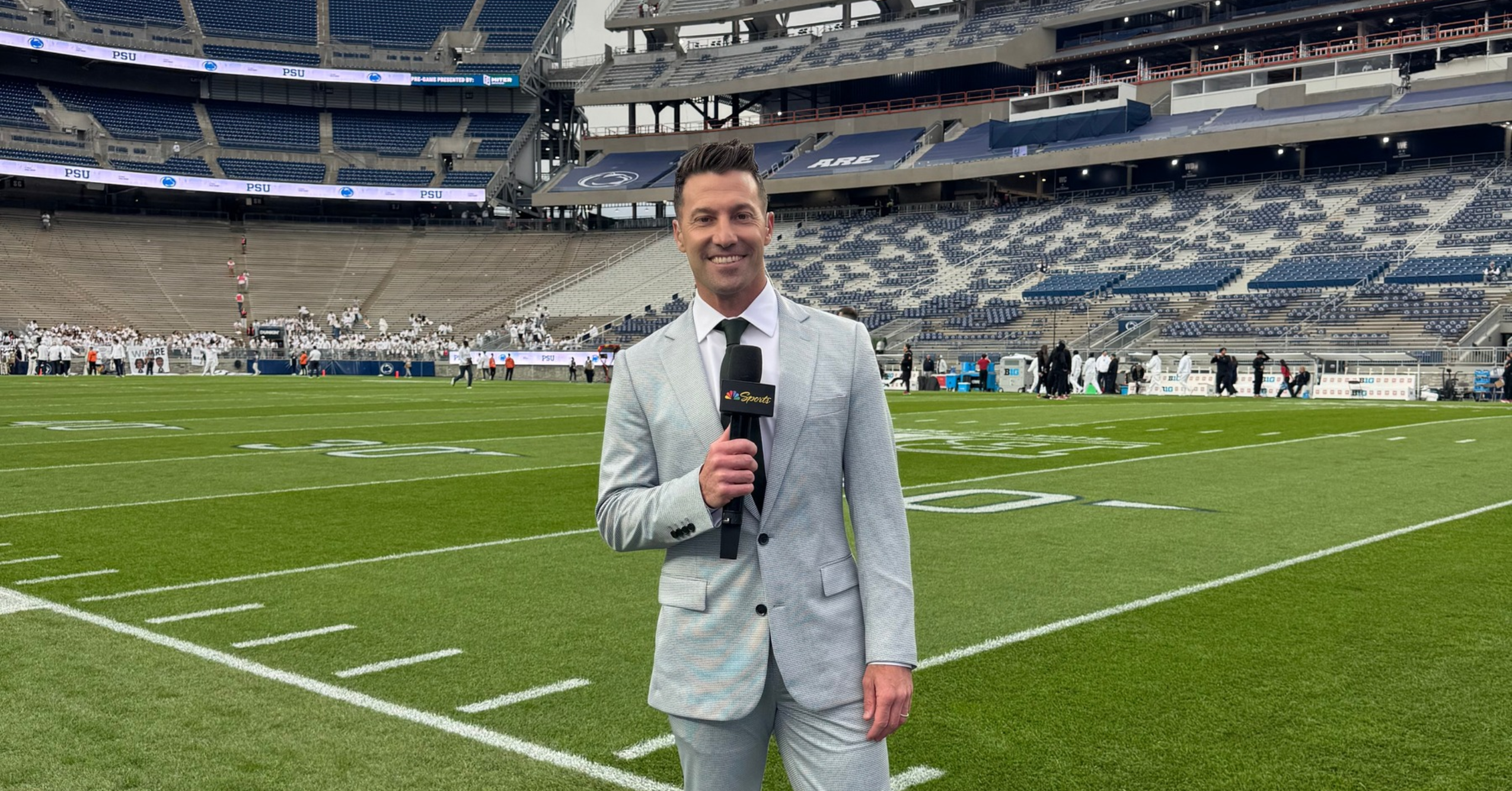
Yogi Roth prepares for a college football broadcast as if he’s still coaching a room full of players. The audience is much larger now: a couple million viewers each Saturday, he says, and his job is to help them see the game more clearly while letting the action decide which stories belong on air.
That approach grew out of a loss. After four seasons working with quarterbacks on Pete Carroll’s USC staff, Roth left coaching and felt a void he couldn’t fill by simply moving into television. He began treating the booth as a different kind of classroom, where preparation gives him the chance to teach without taking the focus away from the game.
“When I left coaching, there’s a big void, you know, and I knew what I was leaving at the time,” Roth told Awful Announcing. “You may not coach four quarterbacks or 50 guys on offense… but you get to go, coach a couple million every Saturday, and I love that part of it.”
Roth is in his 19th year calling college football and his second season at NBC. His work starts well before kickoff: he studies teams, builds a broadcast plan with the production crew and gathers far more material than any single game can hold. The hard part is deciding what the game has earned a viewer’s attention to hear.
A week built around the broadcast
Roth’s preparation begins Sunday evening, after he has spent the day at home with his wife and two sons. He tries to leave football alone until around 6 p.m., then heads to his home office to sketch the following week’s broad themes. He starts with the matchup, staff counts and blitz rates, not a snap-by-snap account. Film study and conversations later in the week can sharpen that first read or make him replace it entirely.
He calls that initial framework a “thesis entering Sunday night.” It gives him a point of view to test as he learns more, rather than a finished script to defend. The distinction matters in a sport where a team’s plan can look different once the opponent, personnel and game situation come into view.
Monday is when the details take over. Roth watches film, reads widely and calls the sports information directors at both schools. He borrowed the practice from veteran broadcasters about 15 years ago and now spends roughly an hour with each contact, asking about details that may never show up in a box score: why one left guard started in Week 2, for example, or how people around the program feel about the season.
Those conversations help him make later meetings with coaches and players more useful. If he has already established the basics, he can ask better questions and get past the answers an audience can find on its own. Roth’s aim is to understand the context behind a lineup or a team’s direction before he enters the booth.
He studies the first team on Monday and the second on Tuesday, collecting notes and using analytics research supplied by NBC to consider how the matchup might unfold. Wednesday morning is the part of the routine he most enjoys: an hour of film study for the full production crew. Roth typically walks them through about 130 plays, calling out packages and tendencies that could matter on Saturday.
The session gives the crew a shared view of the game before it begins. Roth said producers and other staff members come prepared with ideas of their own, often before he starts the film. Their contributions can help the broadcast anticipate what might happen while keeping enough flexibility to respond to what actually does.
By Wednesday evening, Roth tries to put the work aside. He attends his sons’ practices and helps coach their flag football teams. After flying to the game site Thursday, he turns to situational football: late-game choices and halftime adjustments from around the country. He reviews examples with the crew so he can discuss coaching decisions with authority when the game presents a similar moment.
Meetings with the home team and production sessions fill the rest of the week, often extending into Friday night before an early Saturday kickoff. Roth hopes to be watching an engaging game by 6 p.m. and FaceTiming his sons before he calls it a night. The schedule is demanding, but its purpose is straightforward: arrive prepared, then leave room for the broadcast to follow the game.
A long-held NBC ambition
NBC had been Roth’s preferred destination long before he joined the network. He grew up in northeastern Pennsylvania watching its Notre Dame broadcasts, with added local interest because former Irish quarterback Ron Powlus came from the same part of the state. Roth said he held the network in high regard and consistently put it at the top of his list when he and his representatives discussed possible employers.
His opportunity came after the Pac-12 dissolved, leaving him without a network and unsure where he would call games next. The final game on Pac-12 Network featured Notre Dame against Stanford, a pairing that felt like an unlikely preview of what was to come. The following week, Roth was in New York for the Heisman Trophy ceremony, an event he had covered for years. He used the trip to meet with nearly every network covering the sport.
His talks with NBC’s leadership went well, but support from people who already knew his work helped make the decision. Producers and on-air colleagues he considered friends spoke positively about him, and Roth said he felt little need for a formal sales pitch once the door opened.
“It didn’t have to be much of a pitch, you know, it was kind of like, the door’s open, what do you think?” Roth said. “And I was all in.”
A visit to Canton last summer showed him how seriously NBC treats football across its coverage. Roth went to see his former Pitt roommate Larry Fitzgerald enter the Pro Football Hall of Fame, and the network invited him to sit in with Cris Collinsworth and Mike Tirico during the Hall of Fame Game. Seeing the veteran crew at work gave Roth a close look at the standards the network expects throughout its football broadcasts.
“To see that model… filter down to every game, every broadcast, every pregame show, that to me was a really cool thing to see,” he said. “I want to be part of a team, and I want to be part of something greater than myself, and NBC is. They set the bar for me when it comes to sports television, especially around football.”
The sentence that guides his work
Carroll helped Roth begin shaping his broadcasting identity when Roth was 25 and new to television. Asked what kind of broadcaster he wanted to be, Roth said he wanted to be Kirk Herbstreit. Carroll challenged him to find a voice of his own: “What happened to Yogi Roth?”
Roth spent a month developing his style, vision, theme and philosophy, then returned with 36 typed pages. Carroll read them and gave him a more useful task: reduce the ideas to one sentence. Roth eventually settled on a commitment to be youthful, energetic and honest, with facts first, opinion second, and a focus on celebrating the game.
He doesn’t want to be a screamer or a hot-take performer. His years playing and coaching shaped that preference, especially his time alongside Carroll, which Roth likens to earning a PhD from one of the great coaches. He believes understanding what it takes to compete at the highest level should inform analysis without turning every broadcast into a verdict on the people playing.
Roth played receiver at Pitt, but he hasn’t built his credibility on a playing résumé filled with major awards. He points instead to his knowledge of schemes, recruiting and how teams assemble rosters through the transfer portal. Nearly 20 years around college football have also helped him build relationships with coaches, players and staff members who share the details that give a matchup depth.
Early in his broadcasting career, the challenge was using too much of what he knew. Roth said he would find a 2009 broadcast difficult to watch because he tried to fit every insight into the time between snaps. Experience taught him that a live game has its own pace and needs space to unfold.
“You prep and prep and prep, and I’m maniacal in that regard,” he said. “And then you have to walk into the booth and remind yourself that the game is the story.”
That rule shaped Roth’s call of Rutgers at No. 24 Northwestern with NBC play-by-play voice Paul Burmeister. During his visit with the Wildcats, tight end Alex Honig told him about a football education that began more than 4,000 miles away in Bavaria. Honig played for the Schwäbisch Hall Unicorns, one of Germany’s top youth American football teams, before becoming a three-star recruit and, according to 247Sports, the country’s No. 1 quarterback and overall player. He also grew up watching Elite 11 videos on YouTube, learning from the camp where Roth has mentored quarterbacks since 2009.
Roth wanted to tell the story, but he waited for the game to make it relevant. If Honig had spent the afternoon blocking without a target, a long detour into his childhood would have pulled attention from the action. Instead, Honig caught three passes for 34 yards and scored a touchdown against Rutgers, giving Roth a natural opening to bring his background into the call.
“The game will tell us and nudge us to tell a story,” Roth said. “We don’t need to force anything, and if you do, I think with your ear, if you’ve been in it long enough, you can tell when something is getting forced.”
Beyond the quarterback’s ranking
Roth’s connection to Honig reflects years of work at Elite 11, the prominent quarterback camp he has been part of since 2009. His interest in the position began earlier, during four seasons at USC, where he recruited quarterbacks including Tim Tebow and helped bring Mark Sanchez and John David Booty to campus. Since 2005, he estimates, he has crossed paths with nearly every marquee quarterback, often meeting players at 17 and later calling their college games.
Josh Rosen and Sam Darnold stand out to him as an example of how much can change between prospect status and a college career. One reached Los Angeles as a five-star recruit and the other as a three-star; their paths then developed in different ways. Roth’s work with young quarterbacks has also given him a close view of what players and families want to know about the position.
Those recurring questions led him to write Five Star QB, a 600-page book drawing on more than 100 people. About 50 quarterbacks describe living through the recruiting and development process; roughly 50 coaches, general managers and front-office executives offer the perspective of those who shape it.
When Roth speaks to college locker rooms, he reminds players that a ranking can quickly become the first thing people see. He tells them that a jersey and helmet can make an athlete seem like a transaction, even though each player is a son, brother and person with a story beyond football. His point is that players need to find ways to tell that story, so broadcasters can carry it to viewers when the right moment arrives.
His relationship with Elite 11 quarterbacks continues long after they leave the camp. Roth keeps a Thursday call with an alum to talk through whatever is happening in that person’s life. The conversations he values most often have nothing to do with the sport: former campers tell him they married, became fathers or found their first job after football. Some have called while checking into rehabilitation or after completing treatment.
That contact helps Roth remind young passers not to let a position define them. “I think it’s really important for athletes to not identify with the position,” he said. “I am a quarterback? No, no, you are so much more than that.” He cited Malachi Nelson, Jackson Arnold, Avery Johnson and Dante Moore among the players who have come through Elite 11, and described helping them see a life beyond the role as a major part of his work there.
Stephen Greenberg, the supervising producer on Roth’s NBC crew, sees that long view in the broadcast. Roth often sends him old Elite 11 photos showing a starting quarterback as a teenager. Greenberg said those images are one sign of a broader habit: Roth looks for the adversity and setbacks that shaped a player’s journey, rather than presenting a career as a straight line.
Two quarterbacks Roth had discussed would face each other that weekend. Aidan Chiles arrived at Oregon State as a highly regarded recruit and appeared in nine games during his 2023 freshman season, mostly in a limited role. He followed coach Jonathan Smith to Michigan State when Smith took that job, then started 20 games there over two seasons. After Smith was fired, Chiles entered the transfer portal and landed at Northwestern, where he won the starting role in Chip Kelly’s offense over Ryan Boe and West Virginia transfer Nicco Marchiol.
Dylan Raiola’s route has been unsettled in its own way. The five-star recruit in the 2024 class had deep family ties to Lincoln and started nine games for Nebraska. He broke his fibula in the Huskers’ 21-17 loss to Southern California on Nov. 1 last season, then announced that he would transfer from Nebraska to Oregon.
“The only guarantee in life as a quarterback is that it’s not going to go as you imagine and as you envision,” Roth said. The message fits his way of covering the position: the public sees a player directing the offense, but that control doesn’t extend to every turn in a career.
A crew, and a future in storytelling
Quarterbacks often prize control, and broadcasts praise the command they show at the line of scrimmage and in their decisions. Roth’s work with young passers has shown him the uncertainty beyond those moments, including how players choose agents, managers and financial advisers, and how some build fortunes while others lose them. He said Devin Gardner, who attended Elite 11 as a high schooler in 2009 and now works with him at the camp, is the only other analyst he knows with a similar view of those journeys.
Greenberg said Roth’s preparation is matched by a commitment to everyone on the crew. He called Roth an “ultimate teammate,” someone who makes people across the production feel valued and necessary to a strong broadcast. That attitude, Greenberg said, starts with the on-air team and sets the tone for the people working elsewhere on the show.
Roth’s plans at NBC remain open. Week 9 leaves little time to plot the next project, but he is drawn to the network’s history of sports storytelling, from Olympic coverage to feature work. He also sees room for stories around flag football as the sport approaches its Olympic debut. His work with a team in Paris has given him a view of its growth abroad, and he hopes to tell those stories in a live broadcast, podcast, feature or documentary.
Near the end of the interview, Roth returned to a maxim from Chip Kelly: “Praise and blame are all the same.” To him, the work belongs to the crew as a whole, whether he is in the booth at NBC or part of a team at another network.
The sentence Carroll pushed him to find nearly two decades ago still directs Roth’s Saturday work: be youthful, energetic and honest, put facts before opinion, and celebrate the game. His preparation can fill pages, but the broadcast has to stay responsive to what happens on the field. Millions may be watching, yet Roth still approaches them as a room of people ready to learn something—if the game gives him the right moment to teach it.