Elina Naboka Brings a Wider Lens to Surf Filmmaking with “Marketplace”
Across three continents, Naboka has built a body of surf films on her own terms. “Marketplace” turns secondhand ’90s boards into the focus of a two-year project.
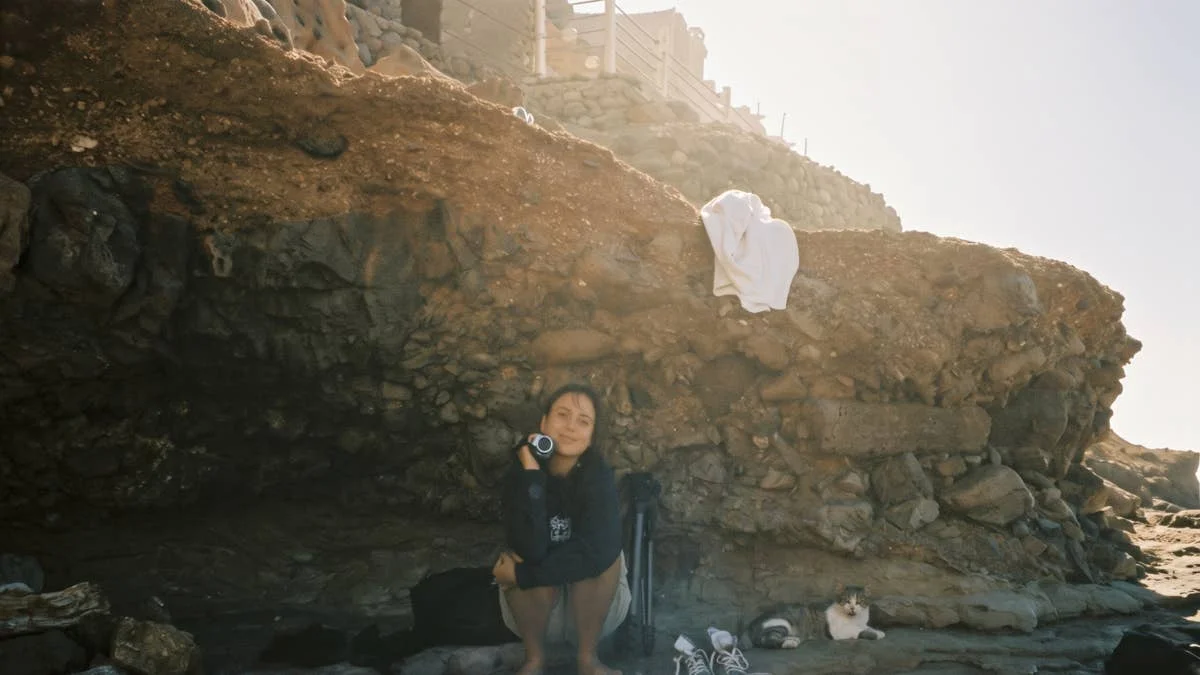
Elina Naboka’s work has traveled from East Coast hurricane swells to Hawaii and the Jersey Shore, but her clearest statement may be a film built around used surfboards. “Marketplace,” made with surfer Simon Hetrick, follows the pair as they surf boards found through online marketplaces, with a particular interest in designs from the 1990s. The premise gives a familiar cultural trend a practical twist: instead of simply revisiting the era’s look, Naboka and Hetrick take its boards into the water.
The film is the third episode in their “See You Next Time” series, a project Naboka says took almost two years to shoot across the United States. Its scale reflects the way she works: filming, directing and editing surf stories, while building connections across surf communities and creative scenes. The work has appeared in surf media, screened on Oahu’s North Shore and reached theaters on the Jersey Shore. “Marketplace” has also been accepted into the Scheveningen Surf Film Festival in The Hague and the Florida Surf Film Festival.
A creative path shaped by the ocean
Naboka was 25 when she took a filmmaking course after spending two months in Indonesia. For one assignment, she made a short surf sketch. Her teacher suggested choosing an indoor subject instead, reasoning that it would let the class see how she handled lighting and equipment. Naboka had a different instinct. She wanted to make films in nature, close to the elements.
That early choice has become the through line of her work. She has filmed large hurricane swells on the East Coast and made surf films that bring the energy of a session into a wider visual story. Her projects have screened on Oahu’s North Shore and premiered in theaters on the Jersey Shore. She has also curated an international art exhibition at a well-known European surf film festival and worked with Levi’s Shoes, Vissla, Salomon Sverige and Faherty.
Those credits span several kinds of production, but the work starts with a direct relationship to surfing. Naboka isn’t approaching the ocean as scenery for a separate story. Her stated aim to film close to the elements points toward a more engaged way of seeing: the waves, boards and people in the water form the subject itself. That perspective has helped her build a body of work across three continents, despite arriving in the United States without an established network in its surf or creative scenes.
Her presence also matters in a field where, as Naboka puts it, women remain a minority. Ashton Goggans, founder of the Center of Radical Education (CORE), describes her as a talented, driven filmmaker whose perspective belongs in surfing. The point is visible in the range of her work: she has moved between filming, editing, directing and exhibition curation, building projects that connect surfers and audiences in different places.
“Marketplace” puts the boards in the story
The boards give the latest “See You Next Time” episode its organizing idea. Naboka and Hetrick sourced used equipment from online marketplaces, focusing especially on 1990s designs. That choice ties the film to a style that has resurfaced across youth culture, including the return of wraparound sunglasses associated with the decade. But the surfboard premise carries the trend beyond its visual references: these are boards to ride, and the film’s concept depends on what happens when they meet the waves.
The project also took shape in distinct locations. Naboka says the series has three parts. Parts 1 and 3 were filmed on the mainland, while the pair flew to Hawaii to shoot Part 2. During that trip, they screened the second episode, “Camel Milk,” at CORE in Oahu during the center’s soft opening. The earlier film also follows Hetrick and Naboka surfing in Morocco, bringing another setting into the series’ wider reach. Watch Simon Hetrick and Elina Naboka in “Camel Milk”.
“Marketplace” premiered this summer at the ShowRoom theater in Asbury Park, New Jersey. Naboka said the screening sold out, with extra chairs added to accommodate the crowd. The film also premiered in Margate and Ocean City, both in New Jersey, before earning its festival selections in the Netherlands and Florida. Those screenings show how a locally rooted surf film can find audiences well beyond the coast where it was made.
For Naboka, the response in Asbury Park was as much about community as the screening itself: she praised the local surf scene for coming together to support the premiere. That reception offers a measure of what the series has built around its films. “See You Next Time” carries a shared surf experience from the water to a theater, then gives viewers in several coastal towns a chance to gather around it.
The next step is the wider release of “Marketplace,” which Naboka has said is forthcoming. Its festival acceptance adds another audience to a project already shown in New Jersey and Hawaii. Follow Elina Naboka on Instagram for updates. Her work suggests the value of making room for more filmmakers who bring their own routes into surf culture: different backgrounds can change what gets filmed, how it gets told and who feels invited to watch.

Paul Grassini