San Clemente’s Vanishing Beach Exposes the Cost of Temporary Seawalls
More than 27,000 tons of rock have narrowed San Clemente’s beach. A Ventura restoration shows how making room for the shoreline can offer another path.
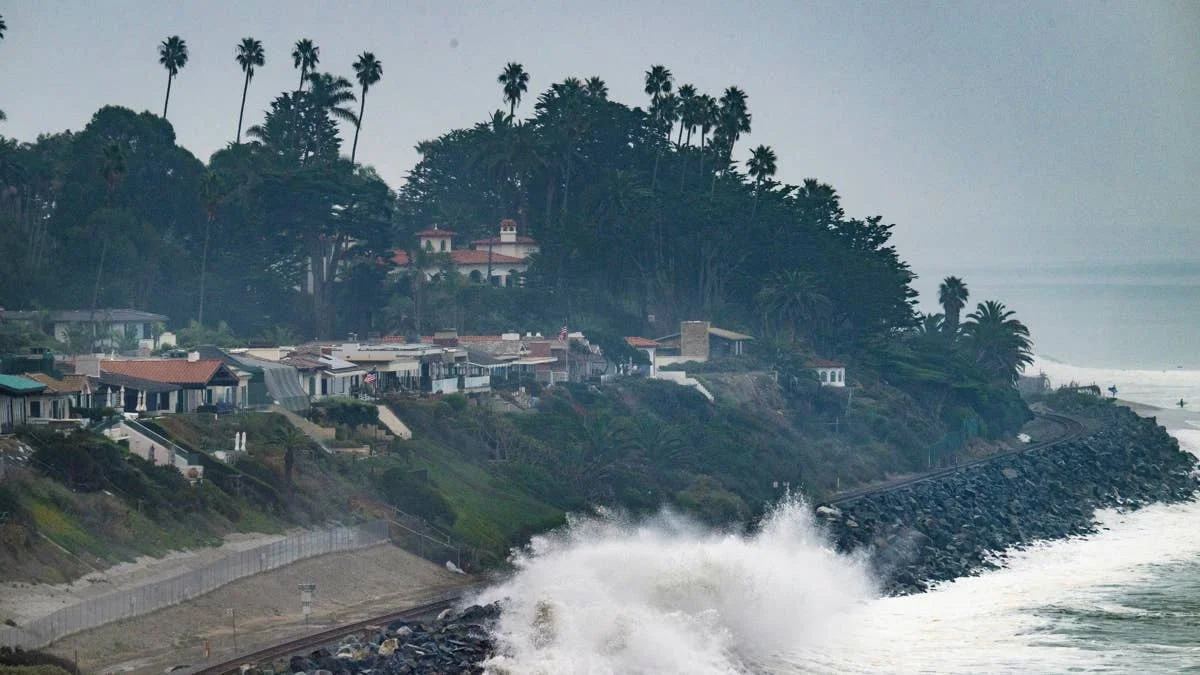
San Clemente’s beach has become the price paid for protecting the railroad beside it. Since 2021, emergency permits have put roughly 27,000 tons of riprap along the rail corridor, according to Surfrider. The boulders have turned a stretch that once linked the Trestles area with the rest of town into an obstacle. Now, with powerful winter surf and another round of king tides on the calendar, the question is whether temporary fixes will keep defining the coast.
View this post on Instagram
Southern California’s beaches are already contending with a punishing El Niño. Buildings have been red-tagged, communities have flooded, and a crack nearly 400 feet long has opened in the bluff beneath Pacific Coast Highway in Orange County. Waves have battered the railroad, while facilities at San Onofre have been damaged and closed. Some beaches are gone; others are reduced to a narrow strip.
King tides are forecast for November 24 to 26 and December 23 to 25, during the season for powerful winter swells. That combination could bring further damage. But the response to coastal threats has followed a familiar pattern: put rock, sandbags or concrete on the beach under an emergency permit, then leave the structure in place.
View this post on Instagram
Surfrider’s 2026 State of the Beach Report describes how emergency armoring can become permanent. The report assessed 30 coastal and Great Lakes states on policies to prevent unnecessary permanent structures. None received an A; 27 earned a C or lower, and 40% received a D or F.
Armoring goes in with weak limits, enforcement falls behind, and the supposedly temporary barrier stays. It can pin the shoreline in place and worsen erosion on nearby properties. The immediate protection comes with a longer cost: less room for a beach to shift naturally as waves move sand and shoreline.
At a recent Coastal Commission meeting in Oceanside, San Clemente residents challenged the continued use of emergency permits, Courthouse News reported. Gary Walsh, chairman of Save Our Beaches San Clemente, said residents had been told four years earlier that officials were studying ways to get sand onto the beach. “Now, in that length of time, SpaceX has managed to build a rocket and send astronauts around the moon,” he told commissioners.
View this post on Instagram
Mitch Silverstein of Surfrider said the group was “dismayed and alarmed to see over 30 emergency permits for armoring across Orange County,” amounting to around 30,000 tons of boulders on public beaches. Commissioner Raymond Jackson of Hermosa Beach challenged the premise of continued emergency measures: “At what point does the word emergency become an indefinite permitting mechanism for something that’s foreseeable, and has been studied for years?”
The latest permit allows the Orange County Transportation Authority and its partners to add up to 15,000 tons of riprap and ballast along nearly a mile of track south of San Clemente State Beach, through next July. The passenger rail line is the only one between Los Angeles and San Diego, putting the agency’s task in sharp focus: protect vital transport links while responding to the shrinking beach beside them.
An OCTA spokesman said the agency understands residents’ frustration and is working to speed plans to place up to 690,000 cubic yards of sand along San Clemente’s beaches. In the meantime, he said, “in locations where waves are directly threatening the railroad and little or no beach remains, immediate stabilization is necessary.”
Jake Howard, SURFER’s editor in chief and a longtime San Clemente resident, said the rock dumping feels out of control and described the response as panicked. He added that other beach communities appear to be following the same course. Silverstein argues that armoring the beach to protect the railroad does neither job well: “Everybody loses.”
The Coastal Commission is expected to consider sand placement next month, with a hearing set for Thursday, November 5, Silverstein said. The meeting is in San Francisco, and members of the public can testify by Zoom. The decision will help determine whether the San Clemente response starts to shift from repeated emergency work toward a larger beach restoration effort.
Ventura offers a different example. At Surfers’ Point, a managed retreat and restoration project completed its final phase in March after decades of work. The bike path and parking lot were moved inland onto Fairgrounds property. Crews rebuilt the shoreline with a cobble berm and sand dunes, giving the beach space to move with the waves instead of locking it in place. The California Coastal Conservancy approved $16.2 million for the work.
View this post on Instagram
That project shows what long-term planning can look like when a shoreline needs room to change. Surfrider recommends that coastal states define emergencies to exclude hazards that can be forecast, require written authorization before emergency structures go in, and limit those structures to two years. It also calls for follow-up plans, including dune restoration and planned relocation.
“An emergency permit should buy time for meaningful adaptation, not become a poor substitute for it,” said Emma Haydocy of Surfrider. El Niño, rising seas and coastal flooding have been anticipated. The test now is whether San Clemente’s emergency measures lead to a lasting plan—or leave the beach increasingly crowded with the barriers meant to protect it.
Related: More Gigantic Kelvin Waves Are Coming to California During Super El Niño